### Diagonal Rule in Sudoku: Understanding Its Importance and Application
#### Introduction
Sudoku, a popular puzzle game, has captivated millions with its simple rules and challenging gameplay. One of the key principles that Sudoku enthusiasts often rely on is the diagonal rule. This article delves into the significance of the diagonal rule in Sudoku and how it can be effectively applied to solve complex puzzles.
#### What is the Diagonal Rule?
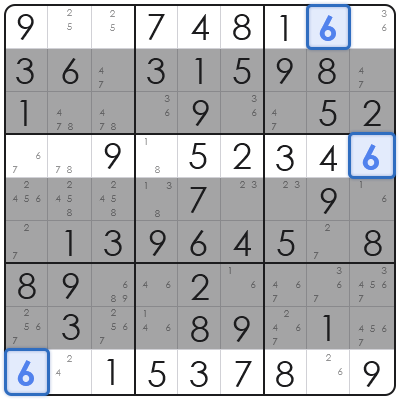
The diagonal rule in Sudoku refers to the arrangement of numbers within the diagonals of the grid. A standard Sudoku grid is a 9×9 grid divided into nine 3×3 subgrids. The diagonal rule states that each of the two main diagonals (top-left to bottom-right and top-right to bottom-left) must contain the digits 1 through 9 without repetition.
#### Why is the Diagonal Rule Important?
The diagonal rule adds an additional layer of challenge to Sudoku puzzles. While the basic rules require that each row, column, and 3×3 subgrid contain all digits from 1 to 9, the diagonal rule introduces a new constraint that can help distinguish between possible solutions.
#### How to Apply the Diagonal Rule
To apply the diagonal rule, follow these steps:
1. **Identify the Diagonals**: First, locate the two main diagonals within the Sudoku grid.
2. **Check for Duplicates**: Scan each diagonal from left to right. As you go, keep track of the numbers you encounter.
3. **Validate Against the Rule**: Ensure that each number from 1 to 9 appears exactly once in each diagonal.
#### Diagonal Rule Examples
**Example 1:**
“`
+——-+——-+——-+
| 1 | 2 | 3 |
| 4 5 6 | 7 8 9 | * |
| 2 3 4 | 5 6 7 | # |
+——-+——-+——-+
“`
In this example, the first diagonal contains the numbers 1, 5, and 9. The second diagonal has 4, 8, and 2. This satisfies the diagonal rule.
**Example 2:**
“`
+——-+——-+——-+
| 1 | 2 | 3 |
| 4 5 6 | 7 8 9 | * |
| 2 3 4 | 5 6 7 | # |
+——-+——-+——-+
“`
In this case, the first diagonal has the numbers 1, 5, and 9, but the second diagonal has 4, 8, and 2. This does not satisfy the diagonal rule, indicating that one of the numbers must be incorrect.
#### Frequently Asked Questions (FAQ)
**Q: Can a Sudoku puzzle have multiple solutions if the diagonal rule is not followed?**
A: Yes, it is possible for a Sudoku puzzle to have multiple solutions if the diagonal rule is not adhered to. However, the puzzle would be considered invalid as it does not meet the rules of the game.
**Q: How does the diagonal rule help in solving Sudoku puzzles?**
A: The diagonal rule can help narrow down the possibilities by ensuring that each diagonal has a unique set of numbers. This can sometimes make it easier to eliminate incorrect numbers from rows and columns, leading to a faster solution.
**Q: Is the diagonal rule a fundamental rule of Sudoku, or is it a variant?**
A: The diagonal rule is a variant of Sudoku, not a fundamental rule. Traditional Sudoku puzzles do not require the diagonal rule; however, many Sudoku enthusiasts enjoy the additional challenge it brings.
**Q: Can I create my own Sudoku puzzles using the diagonal rule?**
A: Absolutely! You can create your own Sudoku puzzles by following the basic Sudoku rules and then applying the diagonal rule to add an extra layer of complexity.
#### Conclusion
The diagonal rule in Sudoku adds an intriguing element to the game, requiring players to pay attention to the arrangement of numbers not just in rows and columns, but also diagonally. By understanding and applying this rule, Sudoku enthusiasts can enjoy a more challenging and rewarding puzzle-solving experience.
