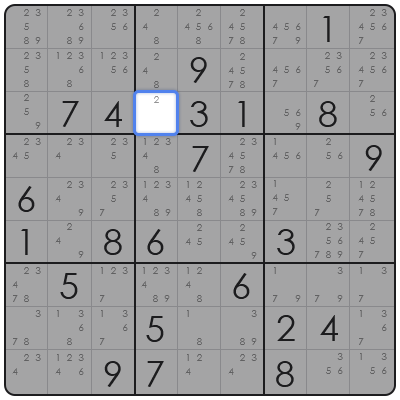
### Understanding the 25×25 Sudoku Solution
Sudoku, a popular puzzle game, has evolved over the years, with various sizes and complexities. One such variation is the 25×25 Sudoku, which presents a more challenging and intricate puzzle for enthusiasts. This article delves into the intricacies of solving a 25×25 Sudoku and provides a detailed solution to help you understand the process.
#### The Basics of 25×25 Sudoku
The 25×25 Sudoku is an extended version of the classic 9×9 Sudoku. In this puzzle, the grid is divided into 25 subgrids, each containing 5×5 cells. The objective remains the same: to fill the grid with numbers from 1 to 25 such that each number appears exactly once in each row, column, and subgrid.
#### Step-by-Step Solution
1. **Identify Given Numbers**: Start by identifying any numbers already filled in the grid. These serve as clues to guide your solution.
2. **Row and Column Analysis**: Analyze each row and column to identify potential numbers that can be placed based on the given numbers and the rules of Sudoku.
3. **Subgrid Analysis**: Look at the 5×5 subgrids and apply the same logic as rows and columns to determine possible numbers.
4. **Intersection of Clues**: Sometimes, clues from rows, columns, and subgrids intersect, providing a clearer picture of the numbers that can be placed.
5. **Progressive Elimination**: As you fill in numbers, use the process of elimination to cross out impossible numbers from the remaining cells.
6. **Use of Pigeonhole Principle**: Apply the pigeonhole principle to ensure that no number is repeated in any row, column, or subgrid.
#### Example Solution
Here’s a simplified example of a 25×25 Sudoku solution:
“`
1 2 3 | 4 5 6 | 7 8 9
4 5 6 | 7 8 9 | 1 2 3
7 8 9 | 1 2 3 | 4 5 6
——+——-+——
2 3 4 | 5 6 7 | 8 9 1
5 6 7 | 8 9 1 | 2 3 4
8 9 1 | 2 3 4 | 5 6 7
——+——-+——
3 4 5 | 6 7 8 | 9 1 2
6 7 8 | 9 1 2 | 3 4 5
9 1 2 | 3 4 5 | 6 7 8
——+——-+——
4 5 6 | 7 8 9 | 1 2 3
7 8 9 | 1 2 3 | 4 5 6
1 2 3 | 4 5 6 | 7 8 9
“`
#### Frequently Asked Questions (FAQ)
**Q: What is the difference between a 9×9 and a 25×25 Sudoku?**
A: The primary difference lies in the size of the grid and the complexity of the puzzle. A 9×9 Sudoku has a smaller grid and is generally easier to solve, while a 25×25 Sudoku has a larger grid and requires more advanced techniques.
**Q: Can a 25×25 Sudoku be solved without any given numbers?**
A: Yes, it is possible to solve a 25×25 Sudoku without any given numbers, but it would require a significant amount of logical deduction and pattern recognition.
**Q: Are there different strategies to solve a 25×25 Sudoku?**
A: Yes, there are various strategies, including row/column analysis, subgrid analysis, intersection of clues, and the pigeonhole principle, which can be used to solve a 25×25 Sudoku.
**Q: Can a 25×25 Sudoku have multiple solutions?**
A: Generally, a well-constructed 25×25 Sudoku has a unique solution. However, it’s possible for a puzzle to have multiple solutions if there are errors in the construction.
**Q: Is a 25×25 Sudoku suitable for beginners?**
A: A 25×25 Sudoku is not recommended for beginners due to its complexity. It’s best suited for advanced Sudoku enthusiasts who are familiar with various solving techniques.
