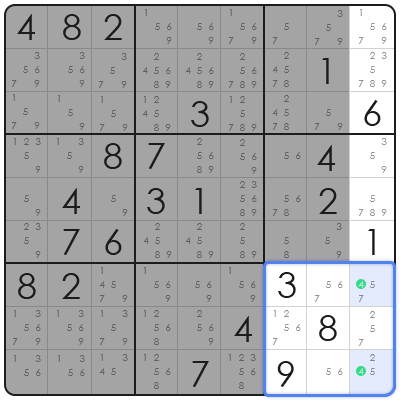
### How to Solve Sudoku via Inference: A Step-by-Step Guide
#### Introduction to Sudoku Inference Techniques
Sudoku is a popular puzzle game that requires logical reasoning and problem-solving skills. One of the most effective methods to solve Sudoku is through inference. Inference involves deducing possible values for cells based on the constraints of the puzzle. This guide will walk you through the process of solving Sudoku using inference techniques.
#### Step 1: Identify Pairs and Triples
Start by identifying pairs and triples. Pairs are cells in the same row, column, or block that can only contain two possible values. Triples are similar but involve three cells. By eliminating these possibilities, you can often narrow down the options for other cells.
– **Example:** In a row, if cells A, B, and C can only be 1, 2, and 3 respectively, then cells D, E, and F in the same row can’t be 1, 2, or 3.
#### Step 2: Use X-Wing and Swordfish Techniques
X-Wing and Swordfish are advanced inference techniques that can be used when you have pairs or triples in two intersecting rows or columns.
– **X-Wing:** This technique is used when you have two pairs or triples in two intersecting rows or columns that share the same two numbers. You can then eliminate these numbers from all other cells in the intersecting columns or rows.
– **Swordfish:** Similar to X-Wing, but it involves four cells in two intersecting rows or columns that share the same number. Eliminate this number from all other cells in the intersecting rows or columns.
#### Step 3: Apply Hidden Pairs and Triples
Hidden pairs and triples are when a pair or triple is not immediately visible but can be deduced by looking at the remaining numbers in the row, column, or block.
– **Example:** If a row has numbers 1, 2, 3, 4, 5, and 6, and cells A, B, and C can only be 1, 2, and 3, then cells D, E, and F must be 4, 5, and 6.
#### Step 4: Utilize Pointing and Box Line Reduction
Pointing involves identifying cells that point to only one possible value based on the remaining numbers in the row, column, or block.
– **Example:** If a cell in a row can only be 1, and it’s the only cell in that row that can be 1, then it must be 1.
Box Line Reduction is a technique used in larger Sudoku puzzles (9×9 grids) to deduce values based on the remaining numbers in the boxes.
– **Example:** If a box has only one possible number for a row or column, that number must go in the empty cell in that row or column.
#### Step 5: Practice and Refine Your Skills
Solving Sudoku is a skill that improves with practice. As you become more comfortable with inference techniques, you’ll be able to solve puzzles more quickly and efficiently.
### Frequently Asked Questions (FAQ)
**Q: What is inference in Sudoku?**
A: Inference in Sudoku refers to the process of deducing possible values for cells based on the constraints of the puzzle, such as pairs, triples, and advanced techniques like X-Wing and Swordfish.
**Q: How do I identify pairs and triples?**
A: Pairs and triples are found by examining the possible values for cells in a row, column, or block. If two or three cells have only one possible value each, they form a pair or triple.
**Q: Can I use inference techniques in all Sudoku puzzles?**
A: Yes, inference techniques can be used in most Sudoku puzzles. However, their effectiveness may vary depending on the difficulty level of the puzzle.
**Q: Are there any online resources to help me practice Sudoku inference techniques?**
A: Yes, there are many online resources, including tutorials, forums, and interactive Sudoku puzzles that can help you practice and refine your inference skills.
**Q: Is it necessary to use inference techniques to solve Sudoku?**
A: While not necessary, using inference techniques can significantly speed up the solving process and make it more enjoyable. Even experienced Sudoku solvers often rely on these techniques to solve complex puzzles.
